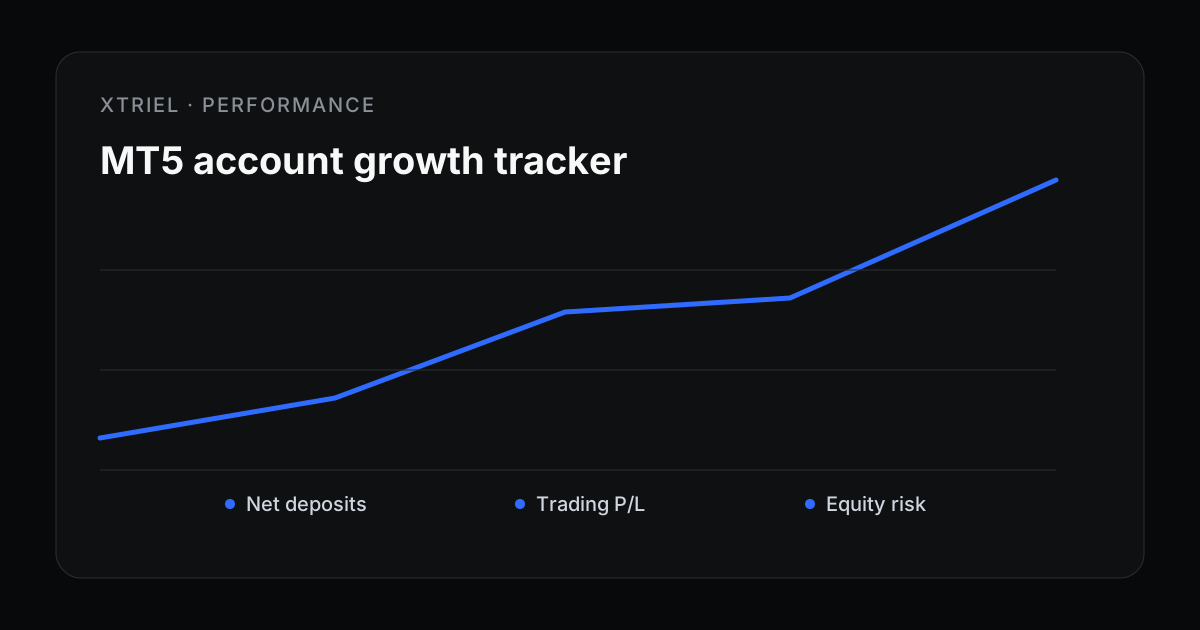
A smooth growth chart can be misleading if it ignores deposits, withdrawals or floating drawdown. The account may look larger because cash was added, not because the strategy improved.
What to track
| Metric | Use |
|---|---|
| Balance growth | Closed account growth. |
| Equity growth | Live growth including floating P/L. |
| Deposits and withdrawals | Separates trading return from cash movement. |
| Max drawdown | Shows the cost of growth. |
Risk-adjusted growth
Two accounts can both be up 10%, but one may have used 3% drawdown while the other used 20%. Track return beside drawdown so the quality of growth is visible.
Sharing performance
If you share performance publicly, show the rules: whether deposits are included, whether equity is live and how drawdown is calculated. For shareable reporting, see xTracker.
Separate trading performance from cash movement
Start with a cash-flow ledger. Record deposits, withdrawals and internal credits separately from trading deals, then calculate return over periods whose beginning and ending capital are known. A balance increase after a deposit is account growth in the everyday sense, but it is not trading return. Label both so the chart cannot imply skill that came from added capital.
Use equity for the live state and balance for closed results. The gap between them is floating P/L. A strategy can show a rising balance while carrying a large open loss, especially if it delays closing losing positions. Plotting both lines exposes that behavior.
Worked example
An account starts at $10,000, receives a $2,000 deposit and ends at $12,600 balance with $12,300 equity. The raw balance change is 26%, but $2,000 came from cash. Trading added $600 on the simple cash-adjusted view, or 6% of starting capital. The live equity result is $300 lower because open positions are losing $300. Report the deposit, the closed-result return and the live equity state together.
When capital changes mid-period, do not casually divide total profit by the final balance. Use sub-period returns or a time-weighted method if the goal is to compare strategy performance independent of deposit timing. A money-weighted method answers a different question: the investor’s return given when cash entered and left.
Judge the quality of growth
- Show maximum equity drawdown beside return.
- Compare rolling weeks or months rather than one all-time percentage.
- Split results by EA magic number, symbol and account where attribution is reliable.
- Flag long balance/equity gaps and unusually concentrated gains.
- Keep the calculation policy visible on any shared report.
A useful review asks whether return improved without a disproportionate increase in drawdown, leverage or concentration. Connect the result to the equity-curve guide, the journal metrics guide and the magic-number attribution guide. Growth is evidence only when its source and risk are visible.
Choose a consistent reporting period
Store daily snapshots at a declared server-time boundary and retain raw cash-flow events. Weekly and monthly reports can then be rebuilt rather than copied from a transient dashboard. If a snapshot is missing, mark the period incomplete; interpolating a smooth line may hide the exact drawdown or cash movement the report is meant to explain.
For comparisons, show absolute P/L, percentage return and capital basis. Add rolling drawdown, recovery time, number of trades and largest contribution by symbol or strategy. A 4% month driven by one oversized trade has a different risk profile from the same return earned across many independent outcomes.
Share the method with the result
A public or investor-facing tracker should disclose whether the line uses balance or equity, the time zone, treatment of deposits and withdrawals, inclusion of commission and swap, and whether results are verified from live telemetry. Avoid annualizing a short sample without a prominent caveat. Retain the original data behind each published period so corrections are traceable rather than silently rewritten.
Primary source
Technical reference: official MetaTrader documentation. Broker and prop-firm terms can differ; verify the rules for the exact account you operate.
xTriel surfaces balance, equity and drawdown so account growth has context.